



最新下载


热门教程
- 1
- 2
- 3
- 4
- 5
- 6
- 7
- 8
- 9
- 10
AI 辅助翻译如何助力新闻编辑室触达新受众——美国新闻项目
时间:2026-07-02 08:38:06 编辑:袖梨 来源:一聚教程网
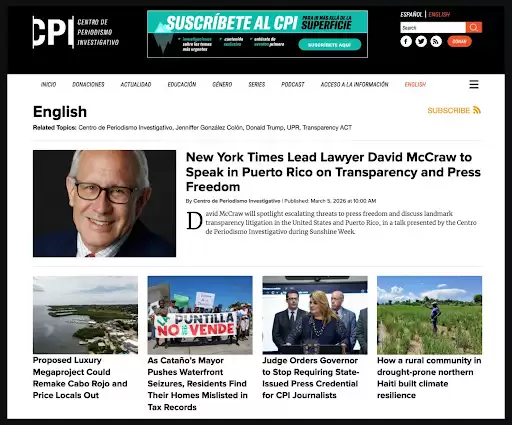
About three years ago, Centro de Periodismo Investigativo’s (CPI) English editor, Noel Algarín Martínez, began experimenting with ways to integrate AI into the Spanish-to-English translation process in his newsroom.
Since then, Algarín Martínez and Annette Ramírez, development director at CPI, have refined their Large Language Model (LLM) prompting approach to get clearer, more useful AI responses. In doing so, they have improved the use of AI for translation in the newsroom.
What’s happening at CPI is part of a shift in how newsrooms are approaching AI-assisted translation work.
In the 2025 Product and AI Studio survey of portfolio members, news organizations in our portfolio reported using LLMs for translation, including English-to-Spanish and text-to-audio translation. This aligns with recent reports from Aspen Digital and the International News Media Association (INMA), which now view AI-assisted translation as a routine task.
At the same time, translation is a nuanced practice, dependent not just on word-for-word accuracy but contextual awareness of the audience and their needs, not to mention the specific dialect of the target language that will most resonate for them. “The challenge remains in ensuring translations capture cultural nuances and read as if written by native speakers,” INMA notes in its research.
Reaching new audiences in English
CPI’s initial goal in 2023 was to better reach people in the Puerto Rican diaspora who increasingly, and in some cases exclusively, consumed news in English, such as younger audiences on the mainland U.S. who do not read Spanish-language outlets regularly.
Since then, the newsroom has made clear progress toward that goal. The translations generated with their new workflows consistently read as natural to native English speakers, with careful attention to rhythm and style that aligns with the expectations of high-quality journalism, Martínez said.
“The AI-assisted translations have effectively preserved the nuances of Puerto Rican contexts, ensuring the stories resonate with diverse audiences without losing their cultural essence,” he said.
During the devastating 2025 Los Angeles wildfires, Boyle Heights Beat used CPI’s prompts to rapidly translate emergency information from English to Spanish for both their website and social media posts. Now, as part of the The LA Local, Boyle Heights Beat continues to use CPI’s updated guidance to serve audiences in both languages.
Building a new AI-assisted newsletter product
Similarly, when Enlace Latino NC used AI-assisted translation to launch its first English newsletter in 2025, the news site had been publishing in Spanish for more than seven years. Nicolás Baintrub, senior reporter and newsletter editor, described early results from this effort during a Product & AI Studio meeting.
Baintrub said the English-language newsletter, launched in June 2025, has brought in an initial set of new donors while expanding their audience. Published twice a month, the newsletter is compiled entirely from Spanish-language stories that are translated into English using their custom GPT workflow.
The newsletter itself was originally written in Spanish and then translated using the same system, he said.
“The publication is helping us reach and engage a new audience and to establish a base of donors that we can cultivate as a new revenue stream,” Baintrub said. “The newsletter also offers another sponsorship opportunity for our work. While we haven’t identified any sponsors yet, the generalized content and growing readership indicate strong future potential.”
Right now, the newsletter has over 1,460 subscribers, and the open rate is even higher than their original Spanish newsletter, he said.
In just the first five newsletters, the AI-assisted workflow saved $6,500 and 150 hours of work, Baintrub said. He estimated these savings based on the typical time and cost required to translate 20 articles across five newsletter sends without AI.
Now, he says they translate eight articles each month, saving approximately $2,500 monthly, compared to the workflow they used previously. Baintrub also said that since incorporating AI, they have not received any translation complaints from readers, unlike in their previous workflow, which used a translation plug-in.
“The translations produced with our custom GPT are significantly higher quality than those generated by the plugin we used previously. In addition to being more efficient, this approach has clearly improved the accuracy, tone and overall readability of our translations,” Baintrub said.
The project confirmed demand for English-language content and has given the small team the confidence to experiment in other areas, such as interactive features and Spanish-language audio scripts drafted by AI and distributed via WhatsApp.
“AI with strong editorial guidance and oversight breaks down language barriers and helps newsrooms to reach new audiences that you couldn’t reach before,” Baintrub said.
Keeping AI workflows human-centered
For CPI’s AI-assisted translation workflow to succeed, Algarín Martínez said those cultural nuances and the “human touch” remain essential parts of the process. Other newsrooms adopting AI for translation are striking a similar balance between AI efficiency and human oversight. At both CPI and Enlace Latino NC, staff require human review, even as the technology itself improves.
“The human remains the core decision-maker, interpreting meaning, assessing tone and ensuring ethical and stylistic consistency,” he said. “AI serves as a supporting tool, helping speed up initial drafts, provide alternate phrasing or ensure consistency across long texts. But the translator and editor apply judgment, context and cultural sensitivity.”
Both organizations report more reliable outputs with GPT-5, the ChatGPT model released in August 2025. The improvements have made it easier to work from AI-generated drafts while maintaining editorial control, they said.
Algarín Martínez said that he has refined his prompts considerably and shifted to working more directly with the GPT-5 model instead of a custom assistant he built in OpenAI’s Playground.
“I’ve found GPT-5 to be much more consistent and nuanced in its translations compared to earlier models,” Algarín Martínez said. “It hasn’t shown hallucinations in my experience, and it reliably translates full texts instead of skipping chunks.”
Guiding a successful AI-assisted translation process
For an AI-assisted translation process to truly succeed, Algarín Martínez said the quality of human expertise guiding it matters as much as the technology itself.
A great translator in this process is not just bilingual, but bicultural: someone who can interpret both the linguistic and cultural nuances of the culture and the broader bilingual audience. Algarín Martínez emphasized that effective translation is not about word-for-word translation, but about preserving meaning and tone while adapting to the context.
“A translator must have a strong grasp of journalistic language, AP style and contextual adaptation, ensuring that stories read as if they were originally written in English, without losing the voice, tone or factual precision of the Spanish source,” he said.
Successful bilingual translators and editors share a few key traits, according to Algarín Martínez:
- Mastery of both languages – including idiomatic expressions and regional phrasing.
- Sensitivity to journalistic tone – ensuring clarity, accuracy and credibility.
- Cultural fluency – adapting local references or expressions for broader audiences.
- Strong editorial judgment – knowing what must stay literal and what can be reshaped for readability.
Algarín Martínez described the relationship between editor and translator as “a collaborative editorial partnership.” Even as CPI incorporates AI tools like GPT-5 into its workflow, the human translator remains the key decision-maker.
“The translator’s role has shifted from producing full translations to focusing on review, correction and quality control,” he said. “Meanwhile, the editor ensures that the final version meets the publication’s journalistic and stylistic standards and resonates with its audience. This collaboration allows the translated story to maintain its journalistic integrity while reading as naturally as an English original.”
Liam Andrew, technology lead at AJP’s Product & AI Studio, said the success in these bidirectional translations from outlets in the portfolio is encouraging. He believes this work could lead to other AI-driven translation products that open new audience and sponsorship opportunities and even shape and expand newsrooms’ identities.
“This work has enabled new products that can reach new audiences,” he said. “It’s exciting to imagine the possibilities for newsrooms across the portfolio. What new products could this inspire in other places and languages?”
Developed by Algarín Martínez and the Product and AI Studio, this Translation Playbook offers a practical guide for other newsrooms looking to adopt similar AI-assisted translation workflows. The playbook and prompt pack resource walks through the translation process step by step, iterating on what the CPI and Enlace Latino NC teams have learned along the way.
This piece was authored by Maggie Cogar.
Sign up for updates
We are building a movement for local civic news. Sign up now to get news, insights, and information about how you can help build the movement.